


What AI Does to the Existing Structure
AI does not introduce new dynamics into the African scaling ecosystem. It accelerates the dynamics already present.
Where the loops are positive, AI compounds them. Where they are negative, AI deepens them. Of the six loops, AI strengthens one. The asymmetry is the central finding. AI's diffusion through the African scaling ecosystem is not net-neutral. It is structurally weighted toward outcomes that compound the architecture's existing failures. The capability trap, the misaligned incentive engine, and the capital architecture mismatch operate independently of AI; AI deployed within those structures reproduces them in higher resolution. The same logic operates one level up. AI changes what structural interventions are practically achievable. It does not dissolve the structures themselves.
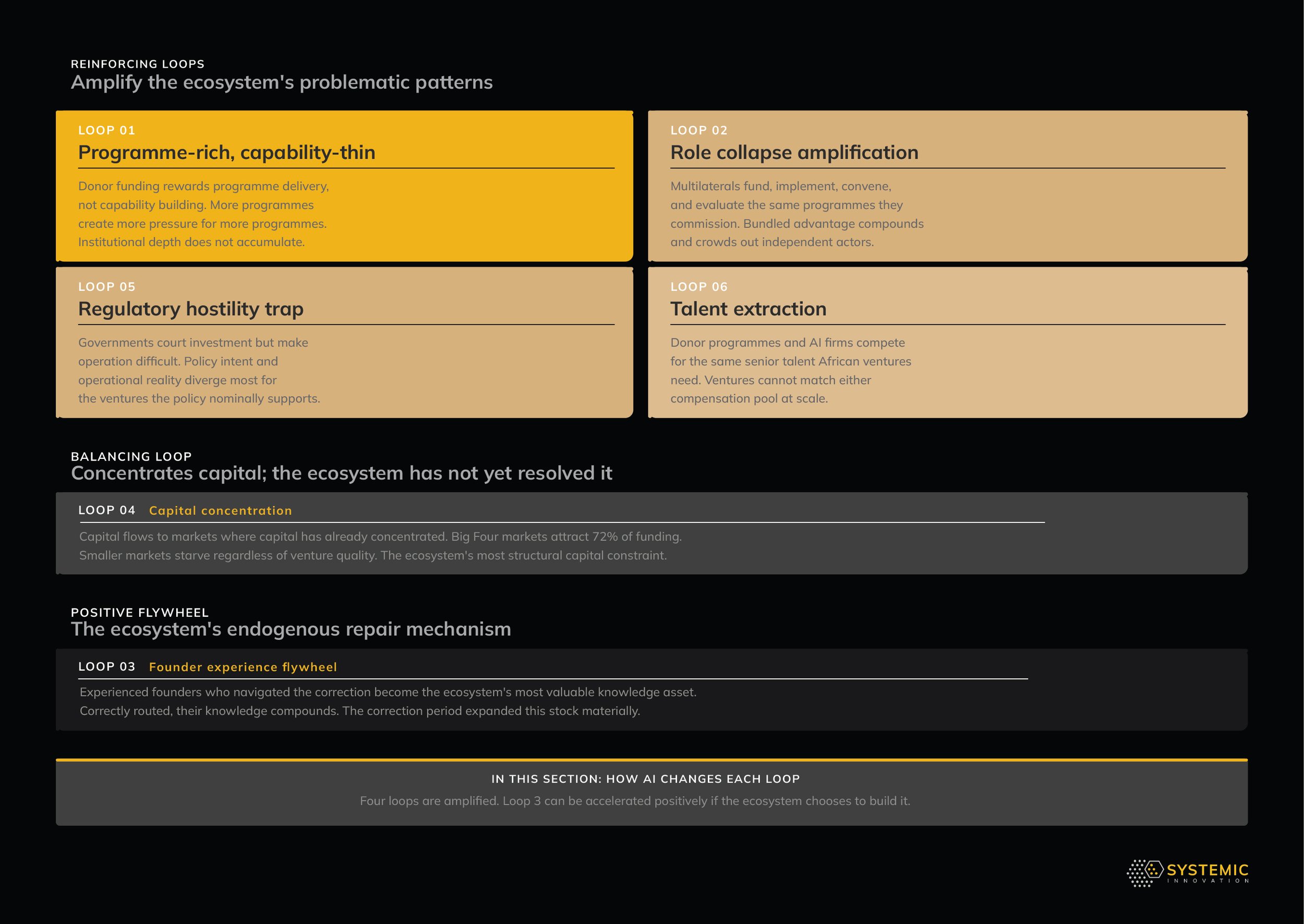
Six Feedback Loops
Loop 1: Programme-rich, capability-thin
The AI label changes; the equilibrium does not. AI literacy bootcamps, AI accelerators, AI sandbox environments - each new programme inherits the funding architecture that produced the original loop and reproduces the dynamic under a different name. Andrews, Pritchett and Woolcock's Building State Capability identifies what is happening: isomorphic mimicry - institutions adopting the form of capability without acquiring the function. AI programmes that mimic Western AI programmes in structure without the capability infrastructure underneath are a textbook case. AI tools could in principle deliver the personalised, demand-led learning the original framework called for. Whether funders build that infrastructure or build more programmes about AI is what distinguishes adaptation from rebadging. AfriLabs's recent ecosystem work points to growing AI-related ecosystem activity, while also emphasising the same underlying readiness, funding and sustainability constraints that characterised the pre-AI support architecture.
Loop 2: Role collapse amplification
The loop deepens against a declining base. The OECD's data records ODA at the lowest level in a decade. As traditional aid budgets contract, ecosystem actors' financial dependence on hyperscaler "AI for good" sponsorship grows. The August 2025 Rest of World investigation documents what hyperscalers gain that classical CSR does not: training-set provenance for African contexts they cannot acquire commercially at the scale or quality their products require. Shikoh Gitau of Qhala, in the investigation: "They are commercial organisations and they're here to win the commercial race. It's not coming from the goodness of their heart. It is coming from the fact that I need data for health." When the same multilateral that funds, implements, and evaluates its own programmes also builds the AI evaluation infrastructure used to assess programme effectiveness, role collapse becomes architecturally embedded. When the institutional alternative - independently funded ecosystem actors - is shrinking against the OECD curve, the dependency compounds.
Loop 3: The founder experience flywheel
This is the loop where AI's diffusion offers genuine ecosystem upside. AI-assisted mentor matching, knowledge capture from experienced founders, and peer-learning networks become tractable in ways that were not in 2022. The 2022–24 correction produced the largest cohort of experienced African founders the ecosystem has ever held. AI tools that capture, structure, and route their knowledge make a Series A founder's hard-won lessons available to a founder approaching the same decision tomorrow. The asymmetry matters analytically: of six loops, AI accelerates one positively. It is also the loop receiving the least programme attention. Funders and ecosystem actors are concentrating effort on loops where AI compounds failure rather than the one where AI compounds success.
Loop 4: Capital concentration
The reciprocity is what changed under AI. Pre-AI, capital concentrated in markets with deeper capital. Post-AI, capital concentrates in markets with both deeper capital and AI infrastructure - the latter increasingly infrastructure capital (data-centre stacks, GPU access, fibre) rather than technology capital. Partech's 2025 data confirms what the loop predicts: the Big Four absorbed 72 percent of total funding in 2025, up from 69 percent in 2024. Kenya led at $1.04 billion, driven by unusually strong debt volumes and a concentration of large transactions, including infrastructure-heavy deals. AVCA's 2025 Venture Capital in Africa records the same concentration pattern at the equity layer. The flywheel is now self-reinforcing in a way it was not pre-AI: AI capital deepens infrastructure depth, which makes the market more attractive for the next AI capital allocation. Deconcentration becomes structurally harder, not easier, as the cycle compounds.
Loop 5: The regulatory hostility trap
Coverage is unprecedented; enforcement is thin. By early 2026, 44 African countries have enacted data protection laws - 80 percent of AU member states; 38 have established operational Data Protection Authorities. Carnegie Endowment's 2025 analysis points to several national AI strategies and two continental strategies have already been published. Kenya's National AI Strategy 2025–2030 launched March 2025; Rwanda approved its national AI policy in April 2023; South Africa's draft National AI Policy was gazetted on 10 April 2026 and withdrawn sixteen days later, on 26 April 2026, after Minister Solly Malatsi confirmed the policy contained fabricated AI-generated academic citations; no revised timeline has been announced; Egypt's second-edition National AI Strategy 2025–2030 targets 7.7 percent ICT/GDP by 2030. Carnegie's April 2026 Africa's Digital Infrastructure Imperative and Digital Policy Alert's continental tracker document the enforcement gap. The diagnostic question is why coverage outruns enforcement. South Africa offers the cleanest contemporaneous illustration as the Draft National AI Policy has some deep irony. The ministry tasked with governing AI lacked the institutional capacity to verify what AI had generated in its own policy. Strategies form against the bargain that does not exist; enforcement does not.
Loop 6: Talent extraction
Two AI-specific dynamics deepen the loop. AI firms globally compete for the same machine-learning engineers, data scientists, and senior product talent African scaling ventures need, at compensation levels even international donor programmes cannot match. The architecture of the AI being deployed compounds the arbitrage layer. Acemoglu and Restrepo's empirical analysis of industrial robot adoption found that increased automation reduced employment and wages in affected regions, with no offsetting job creation elsewhere. Their subsequent argument is sharper: market incentives systematically bias firms toward labour-replacing rather than labour-augmenting technologies - what they term the "wrong kind of AI." The IMF's 2024 analysis extends the concern to developing economies: the earnings complementarity between AI and human workers - the mechanism through which productivity gains translate into wage growth - is substantially weaker in low-skill-intensive economies. The wage-productivity link is structurally weakest precisely where the gains are most needed.
The arbitrage layer documents the consequence. Sama's OpenAI contract paid Kenyan workers $1.32–$2 per hour to label toxic passages while OpenAI paid Sama approximately $12.50 per hour per worker. Daniel Motaung's lawsuit against Meta, brought via Foxglove, for forced labour, trafficking, union-busting, and PTSD remains live. On 16 April 2026, Sama issued formal redundancy notices to 1,108 Nairobi staff after Meta terminated its contract. In March 2024, Scale AI's Remotasks abruptly blocked workers across Kenya, Rwanda, South Africa, and Nigeria with a cold email. The African Content Moderators Union, formed in Nairobi on 1 May 2023, remains unregistered as Kenyan government processing has stalled. The structural interventions that would break the loop - enforceable minimum wages for AI training work, union recognition, compensation benchmarking for senior ML talent - sit within the authority of African governments. They have not been exercised at scale.
What AI cannot fix
The same logic operates one level up. AI changes what is practically achievable. It does not dissolve the structures the achievability is constrained by. The Capital Architecture Mismatch is not addressed by better AI tools. The Partech 15-percent megadeal figure is the empirical proof. The architecture that produces the misalignment compounds with AI capital concentration, not against it. The gender-scaling system is not addressed by AI tools that make investment more data-driven. AI-assisted due diligence calibrated on historical investment data replicates the biases that produced the data. The Dzreke and Dzreke audit is the proof at the lending layer. AVCA's 2026 Gender Diversity in African Private Capital documents the architecture at the investment layer.
Infrastructure dependency is not resolved by more commercial AI deployment. Awarri's N-ATLAS, Nigeria's government-backed large language model, runs on AWS and Google Cloud because Nigeria does not yet have data centres capable of supporting large-scale AI training. The sovereignty framing of national AI strategies cannot be operationalised on a foundation where compute, foundation models, and training-data labour all flow through non-African infrastructure. As Abeba Birhane argued in Algorithmic Colonization of Africa: "When I hear 'data-rich continent' or 'data mining,' my mind goes immediately to the colonial era."
The deeper diagnosis sits in Building State Capability. Andrews, Pritchett and Woolcock describe states that adopt the form of capability without acquiring its function - adopting strategies, frameworks, and institutions whose performance lags the modern norm by decades. The capability trap is the architecture inside which Africa's AI policy is being made. Sam Brien's Only Thirteen Countries Have Ever Done It extends the argument: sustained scaling at this magnitude has been achieved by a vanishingly small number of countries since 1960, and the variables that distinguish them are institutional, not technological. AI does not change which thirteen.
What AI does change is the time available. The window for institutional reform is narrower than it was. Decisions being made now - about data architecture, compute access agreements, AI governance frameworks, foundational model development, and the terms on which African data labour supplies the global AI value chain - will shape the African AI landscape for a generation. Africa's AI moment is not guaranteed. It is available. The cost of coordination failure is not recoverable through subsequent effort.