


A Theory of Ecosystem Change
Most ecosystem interventions in Africa have operated without an explicit theory of change at the system level. They have theories of change at the programme level - if we train X founders, Y will raise capital, Z will create employment. These theories are not wrong. They are operating at the wrong level of analysis. The programme succeeds. The system does not change. The paradoxes persist.
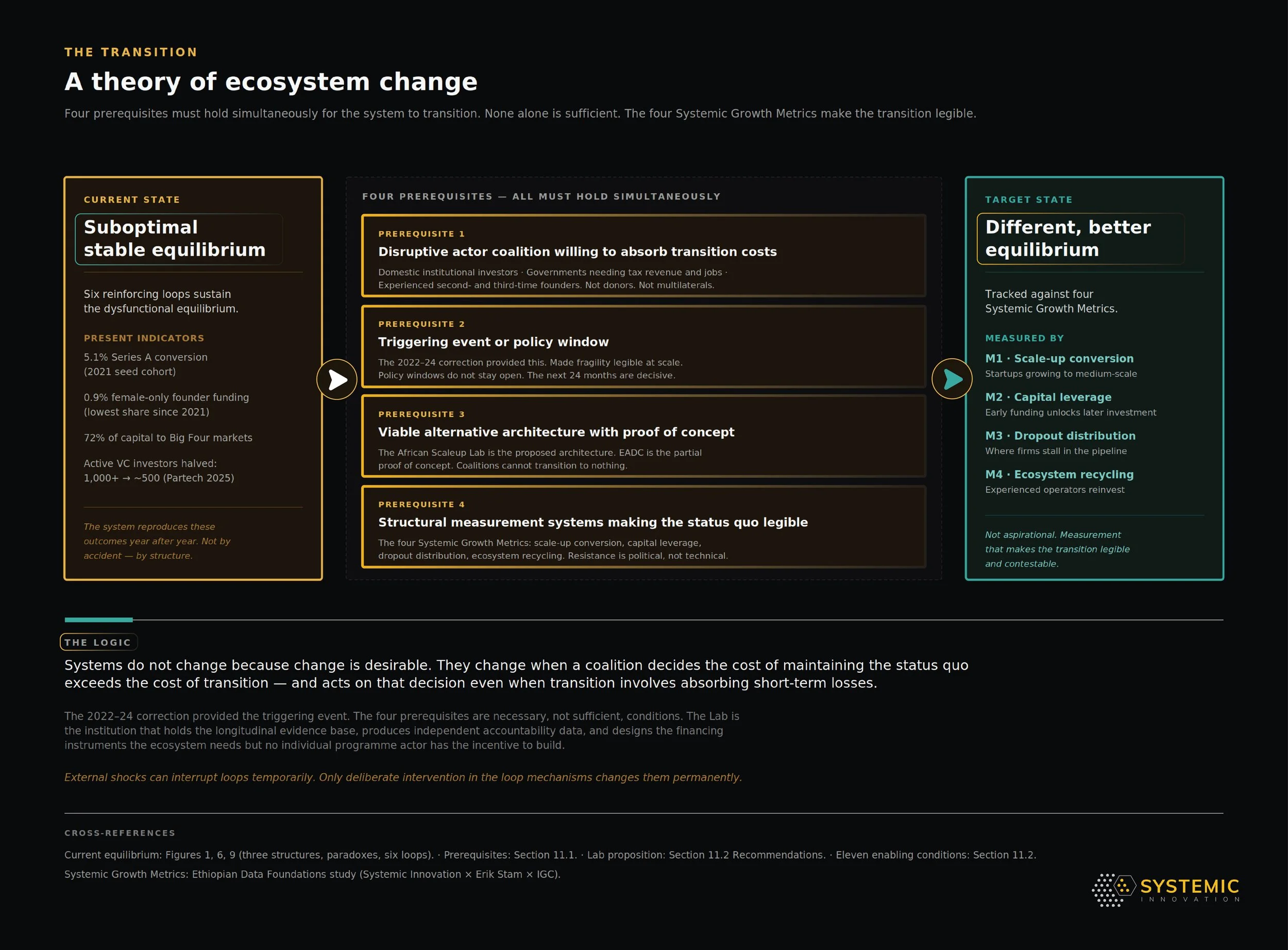
A theory of ecosystem change - as distinct from a theory of programme impact - must explain the mechanism by which a system in a stable but suboptimal equilibrium transitions to a different, better equilibrium. The four prerequisites below are necessary but not sufficient.
A de facto programme, not systems theory of change
The structural foundation for understanding what kind of intervention systems-change actually requires sits in modern systems-thinking scholarship. Donella Meadows' Thinking in Systems - the foundational synthesis of her broader research programme on systems dynamics and intervention - establishes the canonical framework for where to intervene in a system to change it. Her central empirical finding: interventions targeting the operational layer of a system (parameters, programme outputs, individual decisions) produce minimal sustained change because the system's underlying structure rapidly reabsorbs the intervention into its existing equilibrium. The leverage points that produce sustained change are higher in the system: the rules that govern the structure, the information flows that reveal what the structure is producing, the feedback loops that sustain the equilibrium, and at the highest leverage, the paradigm - the underlying assumptions about what the system is for.
The implication for African ecosystem intervention is direct. Programme-level interventions in the African scaling ecosystem are not failing because they are badly designed. They are operating at the wrong leverage point. The programmes succeed at the parameter layer; the equilibrium reabsorbs them at the structural layer. The substantive treatment of how African ecosystem equilibria sustain themselves through self-reinforcing loops - anchored in Greif and Laitin on endogenous institutional change - sits in Feedback Loops. The Meadows framework names what level of intervention would actually shift the equilibrium: rules, information flows, feedback loops, and paradigm - not parameters.
The complementary structural foundation sits in modern transitions scholarship. Frank Geels' Research Policy paper "Technological Transitions as Evolutionary Reconfiguration Processes" - and his subsequent multi-level perspective synthesis - establishes the canonical framework for understanding how socio-technical systems transition between equilibria. The framework operates across three levels: the niche (where alternative practices and institutions develop in protected space), the regime (the dominant configuration of rules, practices, and infrastructure that sustains the current equilibrium), and the landscape (the broader trends and pressures within which both niche and regime operate). Transitions occur when landscape pressure destabilises the regime sufficiently for niche alternatives to scale into a new dominant configuration. The implication for African ecosystem transition is structural. The 2022-24 correction is landscape pressure. The dominant programme-rich, capability-thin regime has been visibly destabilised. Whether viable niche alternatives - institutional architectures developed in protected space that could scale into a new regime - exist at sufficient maturity to absorb the transition is the open question.
The Ethiopian Data Foundations study - developed by Systemic Innovation and Professor Erik Stam with IGC Ethiopia support - advances the operational framework for this section. Rather than treating ecosystem change as a matter of programme improvement, the study introduces four Systemic Growth Metrics that track whether reforms are converting entrepreneurial activity into sustainable scale: scale-up conversion (the proportion of startups growing to medium-scale firms); capital leverage (how effectively early-stage funding attracts later investment); dropout (the share of firms that stall before reaching sustainability, and where in the pipeline that happens); and ecosystem recycling (how far experienced entrepreneurs, employees, and investors reinvest in the next generation of firms). In Ethiopia, approximately 6 percent of post-2010 startups reach the scale-up conversion threshold - comparable to Rwanda but below Kenya - with a flat funding funnel and limited recycling (around 5 percent serial founders). These metrics provide a diagnostic framework: a way to see whether the ecosystem is becoming more capable of turning entrepreneurial energy into cumulative growth.
This framework matters for the theory of change because it shifts the question from "what programmes should be delivered?" to "which conditions, when changed, produce measurable movement in these four metrics?" In Meadows' terms, the metrics operate at the information-flows leverage point - the point where the system becomes able to see what its structure is producing, which is the precondition for any structural change.
The broader frame is useful. The Commission on Growth and Development's 2008 Growth Report, co-chaired by Michael Spence, identified just thirteen economies that had sustained the kind of growth over post-war decades that materially transforms an economy's productive structure - 7 percent annual growth for 25 consecutive years. Two decades on, the list has not grown. Rwanda, Ethiopia, and Cambodia came near the threshold without crossing it. The implication for ecosystem design is sobering: the conditions that produce sustained transformation are structurally rare, and they are not manufactured at programme scale. They are the manifestation of governing orientations maintained across political cycles. This publication operates downstream of that constraint, not upstream of it.

Prerequisites
Prerequisite 1: A disruptive actor coalition willing to absorb transition costs
Systems do not change because change is desirable. They change because a coalition of actors with sufficient combined influence decides that the costs of maintaining the status quo exceed the costs of transition - and acts on that decision even when transition involves absorbing short-term losses. The substantive treatment of which structural interests benefit from the current capital architecture and which interests are harmed by it sits in The Political Economy of Capital Allocation, anchored in Acemoglu-Robinson on extractive institutions, Whitfield-Therkildsen-Buur-Kjær on the politics of African industrial policy, and Mkandawire on African developmental states.
In East Africa, the actors with the greatest potential to form such a coalition are those whose long-term interests are most clearly harmed by the current equilibrium: domestic institutional investors who cannot find investable ventures because the ecosystem cannot produce them at scale; governments whose employment and tax revenue targets cannot be met by programme-rich but capability-thin ecosystems; and the growing cohort of experienced second- and third-time founders who understand, from direct experience, what structural change would actually require.
What this coalition is not: it is not primarily composed of international donors, development finance institutions, or multilateral agencies. These actors have structural interests in programme continuity that are well-documented in the political economy analysis. They can be valuable supporters of ecosystem transition. They are rarely its initiators.
The OECD's data documents a 23.1 percent decline in official development assistance in 2025 - following a 6 percent decline in 2024, the largest single-year drop ever recorded. The trajectory of external capital that has sustained the programme-rich equilibrium is not stable. The actors who need to drive transition are the ones whose survival depends on a different equilibrium, not the ones whose survival depends on the current one.
Prerequisite 2: A triggering event or policy window
Disruptive actor coalitions exist in latent form across many ecosystems. What activates them is a triggering event, a moment when the inadequacy of the current arrangement becomes simultaneously visible to multiple actors, when the political cost of defending the status quo rises, and when alternative arrangements that previously seemed impractical suddenly become credible. In the Geels multi-level perspective introduced earlier, this is the moment when landscape pressure destabilises regime arrangements enough to create the protected space in which niche alternatives can scale.
The 2022–24 capital correction was exactly this kind of triggering event. It made visible, at scale and in real time, the fragility of venture models built on external capital rather than operational capability. The fall in total equity investment, the collapse of Seed-to-Series A conversion to 4.2 percent for the 2022 cohort (substantive treatment in Investor Landscape), and the contraction of active investors to roughly a third of their 2022 number, are not statistics. They are the triggering event made legible.
Policy windows of this kind do not stay open indefinitely. The correction created an opportunity for structural reform. Whether the actor coalition required to act on that opportunity is assembling fast enough to act before the window closes is the critical open question of the next 24 months.
Prerequisite 3: A viable alternative architecture with demonstrated proof of concept
Coalitions cannot transition to nothing. The alternative to the current equilibrium must be specified, and it must be demonstrated to be viable - not in theory, but in at least one operating example that makes the alternative legible to potential participants. In Geels' framework, this is the niche alternative that has developed in protected space and is mature enough to scale when landscape pressure on the dominant regime creates the opportunity.
The FCDO RISA Fund-funded EADC programme matters here, though not only in the way it is usually presented. The substantive treatment of the EADC's role in establishing African knowledge-commons infrastructure sits in Data, Insights and Knowledge. The implication for systems-change theory specifically is that the EADC is also a proof of concept for what a different kind of ecosystem infrastructure looks like: collaborative, evidence-based, institutionally anchored in research and government relationships rather than in short-cycle programme delivery, and explicitly designed to build the capability currently missing rather than provide the services funders currently fund. The EADC evidence base and the three open data platforms, produced over four years, constitute a working model - not a blueprint to be copied, but a demonstration that this kind of infrastructure is buildable and sustainable.
The African Scaleup Lab is the assembled alternative architecture. The substantive treatment of why public capital institutions adopting the form of private capital lose the function only public capital can perform - anchored in Mazzucato's Entrepreneurial State framework - sits in Institutional Actors. The Lab is the African-anchored institutional architecture that holds the mission-driven function. The four Systemic Growth Metrics serve as its measurement framework, operating at the level of international standard-setting rather than national programme delivery. The Lab's ten-year mandate with a built-in sunset is the institutional expression of the stewardship logic this section identifies: building capability that outlasts the institution that built it, rather than perpetuating the institution at the expense of the capability.
The structural risk the Lab proposition must address is named in the substantive treatment of isomorphic mimicry that anchors the multilateral-role-collapse argument in Institutional Actors, drawing on Andrews-Pritchett-Woolcock's Building State Capability. The Lab will fail if it adopts the form of an effective systems-change institution without acquiring the function. The form-replication risk is structurally serious: most donor-funded institutional initiatives in this space have produced exactly that failure mode. The proof of concept is partial. The EADC demonstrated that applied research on high-growth ventures is possible and useful. The Lab must demonstrate that an endowment-backed, independently governed, African-anchored institution can produce the longitudinal accountability data and financing innovation that the ecosystem also needs, while resisting the institutional incentives that pull every institution in this space toward form-without-function. That demonstration is the work of the first three years.
Prerequisite 4: Structural measurement systems that make the status quo legible and contestable
The current ecosystem equilibrium is partly maintained by the absence of measurement systems capable of making its costs visible. Programmes are measured against their own output metrics - participants trained, events held, connections made - not against the scaling outcomes they purport to produce. In Meadows' systems-thinking framework, this is the information-flows leverage point: a system cannot change what it cannot see itself producing. In the absence of independent measurement against scaling outcomes, it is impossible to demonstrate, rigorously and publicly, that the current configuration is failing.
The four Systemic Growth Metrics - scale-up conversion, capital leverage, dropout distribution, ecosystem recycling - are designed to change this. Scale-up conversion is the proportion of startups growing to medium-scale firms within a defined period: a number that can be tracked, published, and compared across ecosystems and across time. Capital leverage tracks whether early-stage funding actually unlocks later investment or simply depletes without compounding. Dropout distribution reveals where firms are stalling - whether at the idea-to-revenue transition, the proof-of-concept-to-commercialisation gap, or the Series A cliff - and directs attention accordingly. Ecosystem recycling measures the degree to which the ecosystem is building the internal feedback loops that make growth self-sustaining rather than externally dependent.
The Series A conversion rate becomes, with this framework, an accountability metric. The gender funding share becomes a system indictment when measured consistently over time, not an anomaly to be explained away. The measurement agenda is not technical. It is political. The resistance to independent, outcome-oriented measurement of ecosystem support programmes is not primarily a data problem. It is an incentive problem.
How this publication expects to matter
A 350-page research publication does not change ecosystem behaviour by being read. It changes behaviour through a specific chain: findings reach decision-makers in forms they can use; those decision-makers face a moment - a budget cycle, a programme renewal, a regulatory review - where the evidence changes what they propose; the proposal is adopted; the structural condition shifts. Each link in that chain can fail. Most do. This publication's theory of influence is therefore explicit rather than assumed. It operates through four pathways simultaneously.
The first is direct policy access.The EADC programme's engagement with MInT in Ethiopia, MINICT in Rwanda, and ecosystem actors across Kenya has placed this publication's findings in the hands of officials with the authority to act on specific enabling conditions. Conditions 5, 7, and 9 are addressed to governments with whom Systemic Innovation has working relationships. The publication is not lobbying from outside. It is evidence from inside.
The second is DFI programme design. FCDO, GIZ, and AFD make programme design decisions on three-to-five-year cycles. The EADC programme itself was commissioned within this cycle. The argument in Conditions 1, 3, and 4 - outcome-linked funding, additionality reporting, structural separation - is designed to be legible to programme design teams within those institutions, not only to their leadership. The evidence standard required to shift a programme design decision is lower than the evidence standard required to shift an institutional policy. That is the threshold this publication is calibrated to clear.
The third is coalition activation. The Growth Firms Alliance, the SA Startup Act Movement, Endeavor Kenya, i4Policy, and the GALI community represent actors with structural interests in a different equilibrium. This publication provides them with a shared diagnostic framework and a shared accountability language. Coalition actors do not need to have read the full document to use its findings. They need the framework accessible in forms their specific audience can act on - which is why the three-structure model, the six-loop architecture (substantive treatment in Feedback Loops), the African Scaleup Lab proposition, and the eleven enabling conditions are each designed to stand alone.
The fourth is the media and intellectual record. "When Multilaterals Compete," "Offshoring African Startups," and "The Math That Doesn't Add Up" reached audiences that formal policy publications do not. This publication is the analytical foundation for that body of public work. Its influence on the intellectual record of African scaling is cumulative and long-run, not event-driven.
None of these pathways is guaranteed. All of them are active.
The publication's theory of influence is not that evidence speaks for itself. It is that evidence, in the right form, at the right moment, reaching the right actor, changes specific decisions. The specificity of the Lab proposition and the eleven enabling conditions - named actors, named resources, named accountability measures, named timelines - is designed precisely to make that theory of influence operational rather than aspirational.